
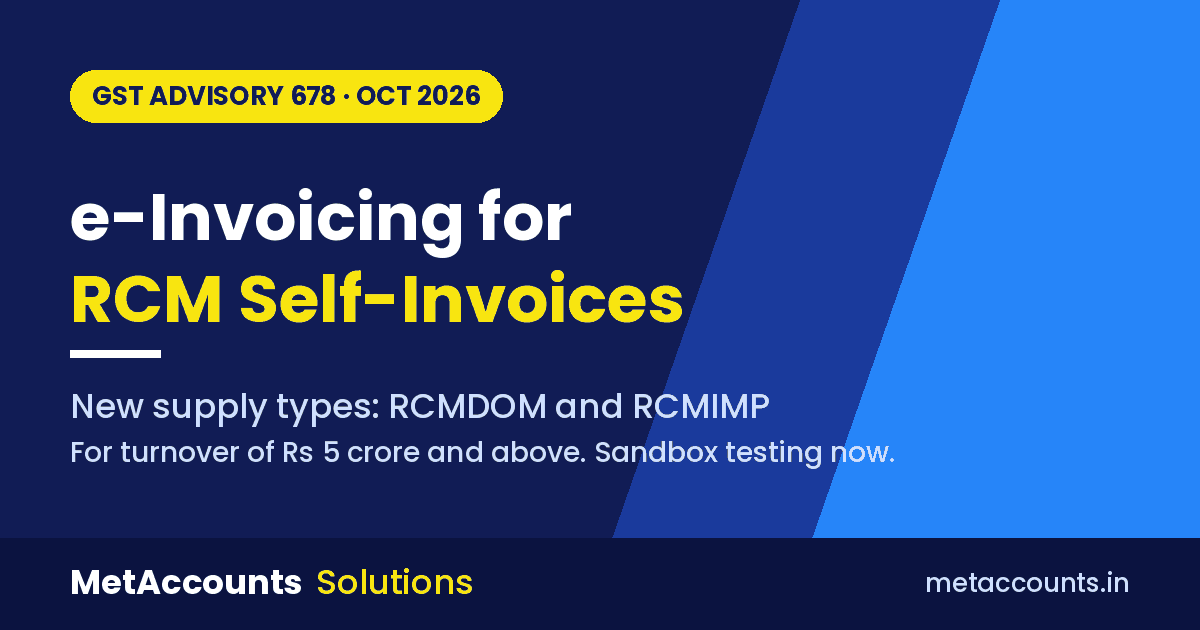
Not mandatory yet: The advisory says the scope, applicability and effective date will be set by separate notifications. Nothing changes in your day-to-day filing until the government notifies it and the production date is announced.
What GSTN Advisory 678 says about e-invoice for RCM
Until now, an e-invoice is normally generated by the supplier. Under reverse charge, however, the registered buyer pays the tax and raises a self-invoice, and these self-invoices were outside the e-invoice system. The GST Council’s 57th meeting recommended extending e-invoicing to such supplies for larger taxpayers. Advisory 678 is the system change that follows: the e-invoice portals are being enhanced so that eligible recipients can report these self-invoices and obtain an Invoice Reference Number (IRN). (Our summary of the 57th GST Council meeting covers the wider recommendations.)
The two new supply types
| Code | Covers |
|---|---|
| RCMDOM | Self-invoices for specified domestic supplies received from unregistered persons, where the registered recipient is liable to pay tax under reverse charge. |
| RCMIMP | Self-invoices for import of services from suppliers located outside India, where the registered recipient pays tax under reverse charge. Think of overseas software, consulting or subscription services. |
Who is affected
- Registered taxpayers with aggregate annual turnover of ₹5 crore and above, the current e-invoicing threshold, who receive these reverse-charge supplies.
- Smaller businesses are not covered by the advisory, though thresholds can change by notification.
- Software providers, ERP vendors and GST suvidha providers also have to prepare their systems.
How reporting will work
- The registered recipient prepares the self-invoice for the reverse-charge transaction.
- The recipient reports it through an authorised Invoice Registration Portal (IRP) and selects RCMDOM or RCMIMP as the supply type.
- After the portal validates the particulars, an IRN is generated.
This reverses the usual direction, where the supplier reports the invoice.
Sandbox and timeline
- Sandbox: the changes are live in the test environments of all six IRPs, so taxpayers, GSPs, ASPs and ERP providers can test integrations now.
- Technical details: NIC IRP-1 will publish a detailed release note with specifications, business validations and validation codes. These will be the same across all six IRPs. Developers can use the NIC e-Invoice API sandbox (einv-apisandbox.nic.in).
- Webinar: GSTN and the IRPs will hold one, with details to follow.
- Production date: not announced. It will be communicated later, together with the legal requirement.
What to do now
- Check whether your turnover is ₹5 crore or more, and list your reverse-charge transactions: supplies from unregistered persons and imports of services.
- Ask your accounting or ERP vendor whether they are testing RCMDOM and RCMIMP in the sandbox.
- Keep vendor details and invoice data clean, because self-invoices depend on them.
- Keep reconciling your reverse-charge liability with your GSTR-3B each month.
- Wait for the official notification before changing any process, and watch the e-invoice portal (IRP-1) for the release note and webinar.
FAQs
What is GSTN Advisory 678?
It is an advisory dated 16 October 2026 announcing an e-invoicing facility for recipient-generated self-invoices under reverse charge, with two new supply types, RCMDOM and RCMIMP.
Is e-invoicing for RCM mandatory from today?
No. The advisory says applicability and the effective date will come through separate notifications. The facility is currently available only for sandbox testing.
Does this apply to small businesses?
The advisory refers to taxpayers with aggregate annual turnover of ₹5 crore and above, the current e-invoicing threshold.
What is an IRN?
An Invoice Reference Number is a unique number generated by the Invoice Registration Portal after your invoice details are validated.
Call +91-85888-99292 or email contact@metaccounts.in for a free consultation.
Based on the official GSTN Advisory No. 678 dated 16 October 2026. Details may change when the NIC IRP-1 release note and the government notifications are issued, so please check them before acting. This post is for general information and is not tax or legal advice.