
Use this free SIP calculator to estimate what your monthly SIP, step-up SIP or one-time lumpsum mutual fund investment could grow to, see its value after inflation, or find the monthly SIP you need to reach a goal.
See what your money will be worth in today’s rupees.
How your investment grows
Year-wise breakup
What is a SIP?
A Systematic Investment Plan (SIP) lets you invest a fixed amount in a mutual fund every month instead of all at once. Investing regularly builds discipline, averages out your purchase cost when markets rise and fall (rupee cost averaging), and lets compounding grow your money over time.
How is SIP return calculated?
- FV – future value of your SIP
- P – monthly SIP amount
- i – monthly rate of return (annual return ÷ 12 ÷ 100)
- n – number of monthly instalments
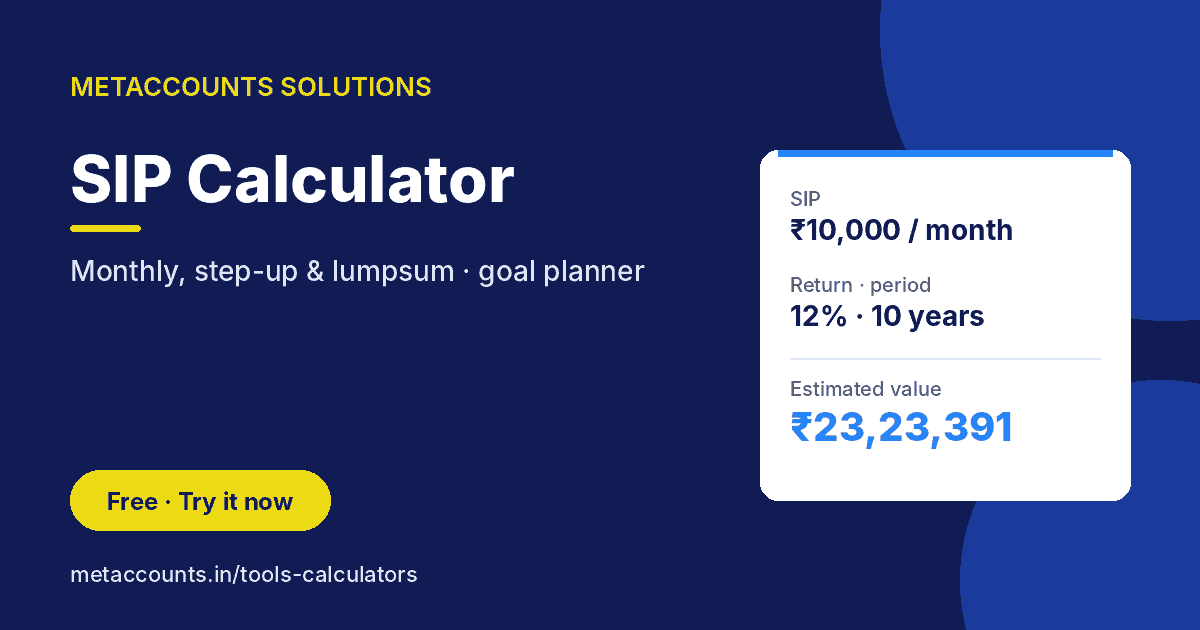
Example: a SIP of ₹10,000 a month for 10 years at 12% a year means you invest ₹12,00,000, and it could grow to about ₹23,23,391, giving estimated returns of about ₹11,23,391.
SIP returns table
Estimated value of a monthly SIP at an assumed 12% annual return. The longer you stay invested, the more of your final corpus comes from returns rather than your own money.
| Monthly SIP | 10 years | 15 years | 20 years |
|---|---|---|---|
| ₹5,000 | ₹11,61,695 invested ₹6,00,000 | ₹25,22,880 invested ₹9,00,000 | ₹49,95,740 invested ₹12,00,000 |
| ₹10,000 | ₹23,23,391 invested ₹12,00,000 | ₹50,45,760 invested ₹18,00,000 | ₹99,91,479 invested ₹24,00,000 |
| ₹25,000 | ₹58,08,477 invested ₹30,00,000 | ₹1,26,14,400 invested ₹45,00,000 | ₹2,49,78,698 invested ₹60,00,000 |
Notice that a ₹10,000 SIP roughly doubles in value between year 15 and year 20. Starting early, and staying invested, matters more than the exact amount.
What is a step-up SIP?
With a step-up (top-up) SIP, you raise your monthly SIP by a fixed percentage every year, usually in line with your salary increments. Even a 10% annual step-up can make a large difference to your final corpus over a long period. Enter an annual step-up above to compare.
SIP vs lumpsum vs fixed deposit
| SIP | Lumpsum | Fixed deposit | |
|---|---|---|---|
| How you invest | Fixed amount every month | One-time amount | One-time amount |
| Returns | Market-linked, not guaranteed | Market-linked, not guaranteed | Fixed when you invest |
| Market timing risk | Low, purchases are spread out | Higher, all money goes in at once | None |
| Suits | Monthly income, long-term goals | Bonus or windfall, long horizon | Short-term needs, capital safety |
| Tax on gains | Capital gains tax, depending on fund type and holding period | Interest taxed at slab rate | |
Use the Lumpsum tab above to compare, and the FD, RD and PPF calculator for guaranteed options.
Why adjust for inflation?
₹1 crore in 20 years will buy much less than ₹1 crore today. Turning on inflation adjustment shows what your future corpus is worth in today’s money, so you can set realistic goals.
How to use this SIP calculator
- Choose the SIP, Lumpsum or Goal Planner tab.
- Enter the monthly amount (or lumpsum), the expected annual return and the number of years.
- Optionally add an annual step-up and an inflation rate.
- See the invested amount, estimated returns, total value and a year-wise breakup. In the Goal Planner tab, enter a target amount to see the SIP you need.
Related tools and services
- FD, RD and PPF CalculatorCompare with guaranteed returns
- EMI CalculatorBalance loan EMIs with investments
- Financial planningGoal-based investment planning
- Income tax filingReport capital gains correctly
Frequently asked questions
How much will a ₹5,000 SIP grow to in 10 years?
At an assumed 12% a year, a ₹5,000 monthly SIP for 10 years (₹6 lakh invested) could grow to about ₹11.6 lakh. Over 20 years it could reach about ₹50 lakh. Returns are not guaranteed.
Are SIP returns guaranteed?
No. Mutual fund returns depend on market performance. This calculator shows estimates based on the return you enter; actual returns may be higher or lower.
What return should I assume?
Many people use 10 to 12% a year for diversified equity funds over long periods, 7 to 9% for hybrid funds and 6 to 7% for debt funds. Past performance does not guarantee future returns, so it is sensible to also check a more conservative figure.
Is SIP better than lumpsum?
A SIP suits regular income and reduces the risk of investing everything at a market high. A lumpsum can earn more if markets rise steadily after you invest. Use both tabs to compare.
What is the minimum SIP amount?
Many mutual funds accept SIPs from ₹500 or even ₹100 a month. The minimum depends on the fund, so check the scheme information document.
How is SIP income taxed?
Gains on equity mutual funds held over 12 months are long-term capital gains, taxed at 12.5% above ₹1.25 lakh a year; gains within 12 months are taxed at 20%. Each SIP instalment has its own holding period. Debt fund gains are taxed at your slab rate. Check the current rules or speak to a tax adviser before investing.
Can I stop or change my SIP?
Yes. Most SIPs can be paused, increased, reduced or stopped at any time without penalty, although exit loads may apply if you redeem units early.
Should I increase my SIP every year?
Increasing your SIP each year, for example by 10% when your salary rises, can grow your final corpus much faster than a flat SIP. Use the annual step-up field to see the difference.
Mutual fund investments are subject to market risks. The figures above are estimates for illustration only and are not investment advice.