
Use this free FD calculator, RD calculator and PPF calculator to find the maturity amount and interest earned on a fixed deposit, recurring deposit or Public Provident Fund account, with a year-wise breakup.
Cumulative adds interest to the deposit (most banks compound quarterly). Payout pays interest to you every month or quarter.
Interest is compounded quarterly, as followed by most banks and India Post.
Assumes you deposit by 5 April each year, so the full year earns interest. After 15 years the account can be extended in blocks of 5 years with contributions.
How your money grows
Year-wise breakup
How FD interest is calculated
P is the deposit, r the annual rate, n the number of times interest is compounded a year (4 for quarterly) and t the tenure in years. Any part-period at the end earns simple interest, and deposits of less than 6 months earn simple interest, as most banks follow.
With a payout FD, interest is paid to your bank account every month or quarter instead of being added to the deposit, so you get back only your principal at maturity. Some banks pay slightly less on monthly payouts because they discount the quarterly interest.
| ₹1,00,000 at 7%, quarterly compounding | Maturity amount | Interest earned |
|---|---|---|
| 1 year | ₹1,07,186 | ₹7,186 |
| 3 years | ₹1,23,144 | ₹23,144 |
| 5 years | ₹1,41,478 | ₹41,478 |
| 10 years | ₹2,00,160 | ₹1,00,160 |
How RD interest is calculated
Each monthly instalment R earns quarterly-compounded interest for the k months it stays invested, so later instalments earn less than earlier ones.
| ₹5,000 a month at 7% | Deposited | Maturity amount |
|---|---|---|
| 1 year | ₹60,000 | ₹62,311 |
| 3 years | ₹1,80,000 | ₹2,00,686 |
| 5 years | ₹3,00,000 | ₹3,59,664 |
How PPF interest is calculated
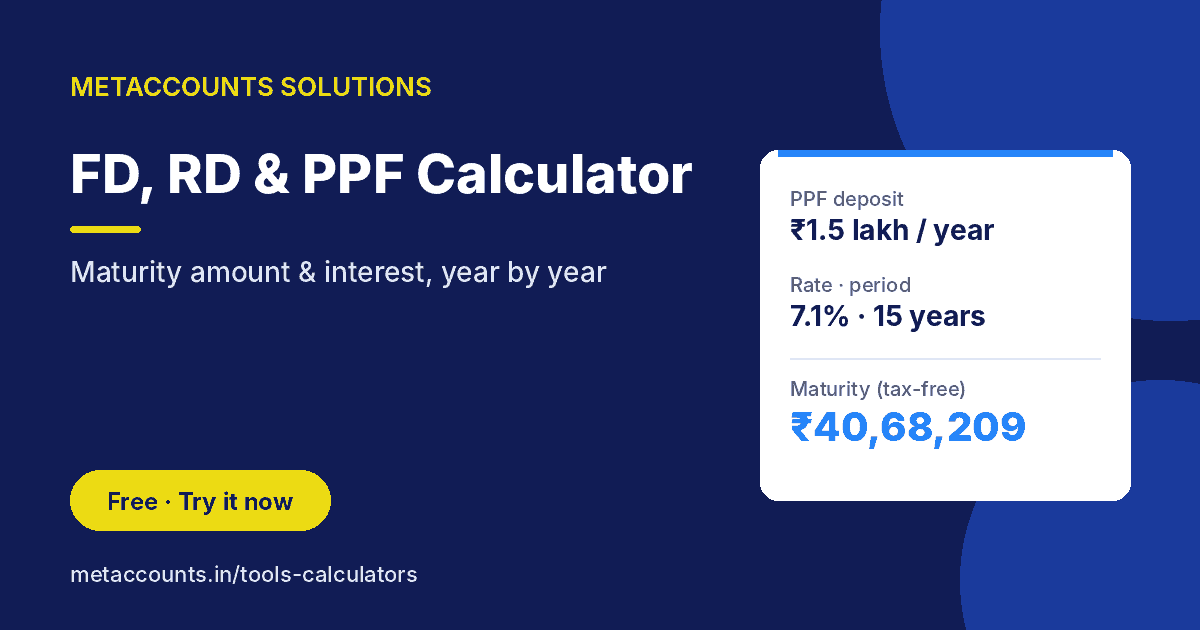
PPF interest is calculated monthly on the lowest balance between the 5th and the last day of the month, and credited once a year. Depositing by 5 April earns interest for the full year. The account matures after 15 years and can be extended in blocks of 5 years. The calculator uses the current rate of 7.1% a year (October–December 2026), which the government reviews every quarter.
| ₹1,50,000 a year at 7.1% | Invested | Maturity amount |
|---|---|---|
| 15 years | ₹22,50,000 | ₹40,68,209 |
| 20 years (one extension) | ₹30,00,000 | ₹66,58,288 |
| 25 years (two extensions) | ₹37,50,000 | ₹1,03,08,015 |
FD vs RD vs PPF: which is better?
| Fixed deposit | Recurring deposit | PPF | |
|---|---|---|---|
| How you invest | One-time amount | Fixed amount every month | ₹500 to ₹1.5 lakh a year |
| Tenure | 7 days to 10 years | 6 months to 10 years | 15 years, extendable by 5 |
| Interest | Fixed for the tenure | Fixed for the tenure | Reset every quarter by the government |
| Tax on interest | Taxable at slab rate, TDS may apply | Taxable at slab rate, TDS may apply | Tax-free (EEE) |
| Liquidity | Premature withdrawal with penalty | Early closure with penalty | Partial withdrawal from year 7 |
| Best for | Parking a lump sum safely | Saving from monthly income | Long-term, tax-free savings |
For goals more than 5 years away, you may also compare market-linked options with the SIP calculator.
Tax and TDS on deposits
Interest on bank and post office FDs and RDs is added to your income and taxed at your slab rate, whether or not you receive it. Banks deduct TDS at 10% when your interest from that bank in a year exceeds ₹50,000, or ₹1,00,000 for senior citizens. If your total income is below the taxable limit, you can submit Form 15G (or Form 15H if you are a senior citizen) to avoid TDS. Tax-saving FDs with a 5-year lock-in and PPF deposits qualify for a deduction only under the old tax regime.
How to use this calculator
- Choose the Fixed Deposit, Recurring Deposit or PPF tab.
- Enter the amount, interest rate and tenure. For FDs, pick the compounding frequency and whether interest is reinvested or paid out.
- See the maturity amount, total interest and a year-wise breakup, which you can download or share.
Related tools and services
- SIP CalculatorCompare with mutual fund SIPs
- EMI CalculatorPlan a loan alongside your savings
- Financial planningBuild a savings plan with us
- Income tax filingReport interest and claim deductions
Frequently asked questions
What will ₹1 lakh become in an FD in 5 years?
At 7% a year with quarterly compounding, ₹1,00,000 grows to about ₹1,41,478 in 5 years, earning about ₹41,478 in interest. Enter your bank’s rate above for an exact figure.
Is FD and RD interest taxable?
Yes. Interest on bank FDs and RDs is added to your income and taxed at your slab rate. Banks deduct TDS at 10% when your interest from that bank in a year exceeds ₹50,000, or ₹1,00,000 for senior citizens; you can submit Form 15G or 15H if your total income is below the taxable limit.
Is PPF tax-free?
Yes. PPF is in the exempt-exempt-exempt (EEE) category: interest and the maturity amount are tax-free, and deposits up to ₹1.5 lakh a year qualify for a deduction under the old tax regime. The new tax regime does not allow this deduction.
What is the current PPF interest rate?
The PPF rate is 7.1% a year for October to December 2026. The government reviews small savings rates every quarter, so check the latest notification before you invest.
How often does the PPF rate change?
The government reviews small savings rates every quarter. The rate in force applies to your whole balance for that period, so actual returns can differ from this estimate if the rate changes.
Are bank deposits insured?
Deposits in a bank are insured by DICGC up to ₹5 lakh per depositor per bank, including principal and interest.
Which is better, FD or RD?
An FD suits a lump sum you already have, and earns interest on the full amount from day one. An RD suits saving a fixed amount from your monthly income. For the same rate, an FD earns more on the same total amount because the money is invested longer.
Can I withdraw early?
Most bank FDs allow premature withdrawal with a penalty, usually 0.5 to 1% lower interest. RDs can usually be closed early on similar terms. PPF allows partial withdrawals from the 7th financial year and loans from the 3rd to 6th year; premature closure is allowed only in specific cases after 5 years.
Official sources: India Post (PPF, RD) · DICGC deposit insurance · Reserve Bank of India
Results are estimates for illustration. Actual maturity values depend on your bank’s or post office’s rules, rate changes and the dates of your deposits.